Turning Market Signals into Strategic Growth with AI-Powered Intelligence Modern businesses opera
Modern businesses operate in markets where customer expectations, competitor strategies, and industry trends can change rapidly. Companies that rely only on traditional research methods may struggle to recognize important developments before they affect revenue. This is where ai agents for competitive intelligence and customer churn prediction software can support a more responsive approach to business decision-making. By combining automated market monitoring with customer-focused analytics, organizations can identify emerging opportunities, understand changing behavior, and make informed strategic adjustments.
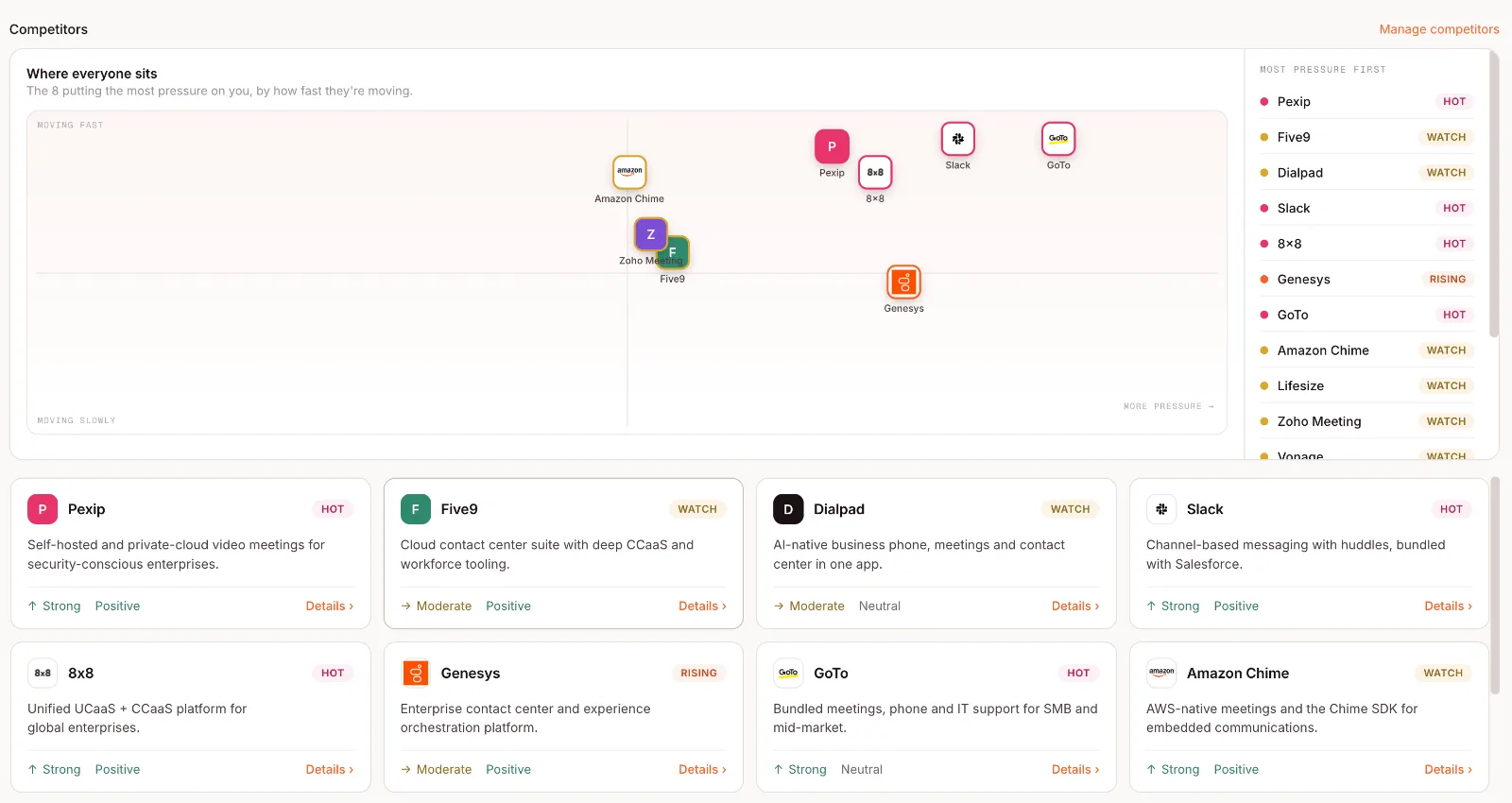
The growing demand for ai agents for competitive intelligence reflects a broader shift toward continuous business intelligence. Instead of depending entirely on periodic reports or manually collected information, companies can use intelligent systems to monitor relevant market signals on an ongoing basis. These systems can help teams organize large volumes of information, identify meaningful patterns, and bring important developments to attention without requiring employees to spend hours reviewing sources individually.
Competitive intelligence has traditionally involved collecting information about competitors, products, pricing, positioning, customer sentiment, and broader industry developments. While these activities remain valuable, the scale of available information has increased considerably. Businesses now have access to websites, public announcements, reviews, social conversations, product updates, industry publications, and many other sources of information. An intelligent approach can help transform this constantly changing information into a clearer view of the competitive environment.
AI agents can be particularly useful because they can be designed to perform recurring research tasks. Rather than treating intelligence gathering as a one-time project, businesses can establish processes that continuously observe selected signals. When a competitor changes its product offering, introduces a new feature, adjusts messaging, or enters a new market, automated systems can help surface the development. Human teams can then evaluate the significance and determine whether a response is appropriate.
Another important area of business intelligence is customer retention. Acquiring new customers often requires significant marketing and sales investment, making customer retention an important consideration for sustainable growth. Customer churn prediction software can help organizations examine behavioral patterns that may indicate an increased likelihood of customers leaving. By analyzing factors such as engagement, purchasing activity, support interactions, product usage, and changes in account behavior, predictive systems can help teams recognize potential retention challenges earlier.
The value of predictive churn analysis does not come simply from identifying customers who may leave. Its greater usefulness comes from helping businesses understand why customer relationships may be weakening. For example, declining product usage could indicate that a customer is struggling to achieve value from a service. Repeated support issues may reveal dissatisfaction, while reduced engagement could suggest that a competing solution is attracting attention. These signals can give customer success and marketing teams a stronger basis for developing appropriate retention strategies.
When competitive intelligence and customer analytics are considered together, businesses can develop a more connected understanding of their markets. Competitor activity may influence customer expectations, while changes in customer behavior can reveal weaknesses or opportunities within a company's own offering. Connecting these perspectives can help decision-makers move beyond isolated datasets and develop a broader picture of what is happening across the customer and competitive landscape.
This approach can also improve collaboration between departments. Marketing teams may use competitive insights to refine messaging, while product teams can identify areas where customer expectations are changing. Sales teams can use market intelligence to better understand competitive conversations, and customer success teams can use behavioral signals to identify accounts requiring additional attention. A shared intelligence framework can therefore reduce information silos and help different teams work from a more consistent understanding of market conditions.
Automation can also make research more scalable. As businesses expand into new regions, product categories, or customer segments, the volume of information requiring analysis can grow quickly. Intelligent systems can assist with repetitive monitoring and organization, allowing employees to focus more heavily on interpretation, strategy, creativity, and relationship management. This balance between automation and human judgment is important because business intelligence should support decision-making rather than remove human responsibility from it.
Data quality remains an important consideration. Predictive systems are only as useful as the information they receive and the way their outputs are interpreted. Businesses should therefore establish clear data practices, review analytical assumptions, and ensure that employees understand the difference between a useful signal and a definitive conclusion. Customer predictions should be treated as indicators that can guide investigation rather than unquestionable outcomes.
Privacy and responsible data use are equally important when working with customer information. Organizations should collect and process information according to applicable laws, internal policies, and customer expectations. Clear governance can help businesses use advanced analytics while maintaining appropriate controls around sensitive information. Responsible implementation can also strengthen trust among customers and employees.
For growing companies, platforms such as Hyperorbit.ai can fit into a broader strategy focused on making intelligence more accessible across the organization. The objective is not simply to collect more information, but to turn relevant information into useful context that teams can understand and act upon. When technology reduces the time required to discover important signals, employees can dedicate more attention to strategic planning and customer relationships.
The future of business intelligence is likely to involve increasingly connected systems that combine competitive monitoring, customer analytics, market research, and organizational knowledge. Companies that establish these capabilities can create processes for continuously learning from both external market developments and internal customer behavior. Instead of reacting only after a major change becomes obvious, teams can develop earlier awareness and investigate potential opportunities or risks while there is still time to respond thoughtfully.
As this landscape develops, ai agents for competitive intelligence can help businesses maintain awareness of competitors and market movements, while customer churn prediction software can provide valuable insight into changing customer behavior. Used together with reliable data, thoughtful human analysis, and responsible governance, these technologies can help organizations build a more continuous approach to intelligence and create stronger foundations for informed business decisions. Hyperorbit.ai represents a technology-focused environment where such intelligence-driven approaches can support organizations seeking to understand their markets and customers more effectively.

Comments
Post a Comment